


“Gold lies in retail.” Jiří Kuchyňa on where Aireen has got to a year after winning AppParade
Last November we brought AppParade back to the Bio Oko cinema after years away and, for the first time, dedicated the whole evening to projects built on AI. Almost two hundred people came, and the audience alone chose the winner. They picked Aireen, a project that had already been running in live clinical practice for several years.

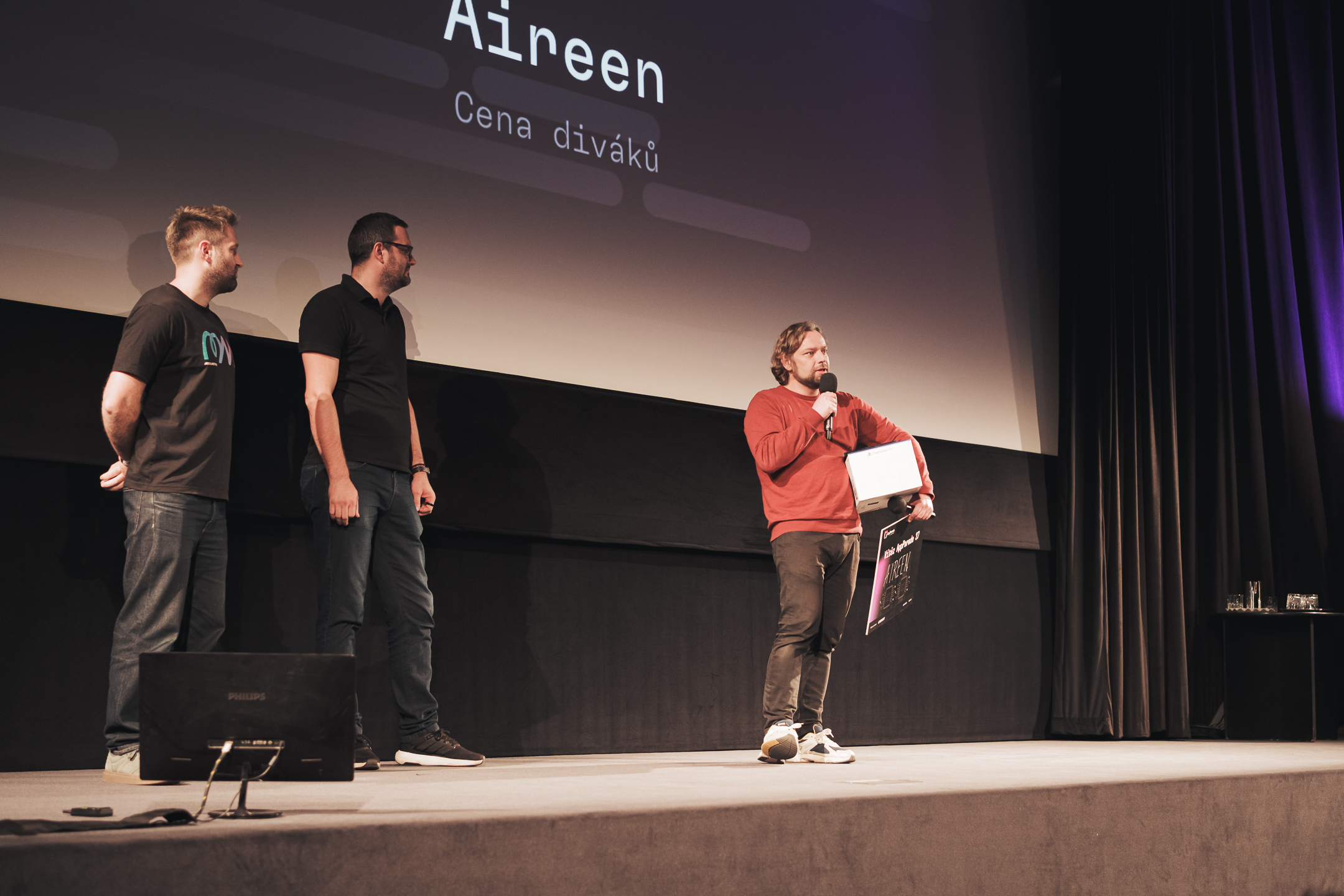
Last November we brought AppParade back to the Bio Oko cinema after years away and, for the first time, dedicated the whole evening to projects built on AI. Almost two hundred people came, and the audience alone chose the winner. They picked Aireen, a project that had already been running in live clinical practice for several years. That is still a rarity on the Czech AI scene. In my report from that evening I described medical AI as a long game, where the road to results is measured in years of certifications and clinical studies.
Aireen is a Czech medtech company from the Channel Lab group whose artificial intelligence detects signs of diabetic retinopathy in a photo of the retina. It is a complication of diabetes that does not hurt for a long time and that patients often don't know about until it threatens their sight. Any trained health professional can take the image, so screening happens right at the diabetologist's office, and it is now heading into opticians too. The company was the first Czech AI startup to obtain medical device certification under the European MDR regulation (class IIb), and it has a clinical study on 1,274 patients behind it. This January it added a partnership with Finland's Optomed: Aireen's algorithm now also works with a handheld camera that fits into a small case.
Winning a competition is a nice moment, but I am always more interested in what comes next. So almost a year after the winning night at Bio Oko, I asked Jiří Kuchyňa what has really changed at Aireen. His answers make it clear that a year in healthcare counts differently from a year in the world of apps. He talks about why one EU is in fact 27 different healthcare systems and why the gold lies in retail. He explains why Europe is not building the datasets medical AI could learn from, and where the algorithm's work ends today and the doctor's begins.
He also has a message for those who will stand on the same stage on 11 November. AppParade #38 is once again taking place at Bio Oko, ten projects will make it to the final, and the audience in the hall will pick the winner. This year we are asking a simple question: now that AI lets you build almost anything, what is actually worth building, and what will still be here in a year? Aireen is a fairly convincing answer to that second question. You can reserve your seat at appparade.cz.
Last November you won AppParade #37 at Bio Oko by audience vote. What did that evening and the weeks after it actually bring you?
We were really pleased with the whole event and its outcome. From my point of view, the biggest benefit was the praise the whole team received from the audience. It definitely raised our visibility too, and both current and potential investors noticed it.
Is there a specific contact, conversation or moment that came about thanks to AppParade? And what would you say to this year's AppParade #38 finalists, who will stand on the same stage on 11 November?
Our Czech investor and startup pond is small: we know each other and talk regularly. So I can't really give an example of someone who didn't know us and started talking to us because of AppParade. But what matters, and this is also my message for this year's finalists, is that it's not about a few LinkedIn posts or a couple of newspaper articles. The startup world is hugely competitive. Even if we have different products, we go after the same investors. Fairly “beating” the competition is something that simply counts in this world and earns you points with investors.
Over the past year you signed a partnership with Optomed and started talking about screening as a service, where a doctor doesn't have to buy a camera first. Besides ophthalmologists, your website now also targets opticians, screening programmes and camera distributors. If you had to pick the single change that accounts for most of that year, which would it be and why?
I'd sum it up as “international expansion”. All the steps above lead towards that goal. It's great to be able to sell to doctors, but even within the EU it's a system that is very hard to scale. After all, one EU still means 27 completely different healthcare systems, in terms of reimbursement, the patient journey, the powers of individual medical specialities and so on. The gold lies in retail. On the one hand it's the most effective place for screening, because we are where the patients are, and on the other it's exactly the scalable model. Opticians work in a very similar way in most countries.
This January Optomed announced that its handheld Lumo camera can be used in the EU with your algorithm for diabetic retinopathy screening. You said the integration meant you had to validate the model again. What did that involve, and what did it change about where and by whom screening can be done?
Let me correct that slightly. We didn't have to revalidate the model itself, but the integration affected the part that concerns the medical device, so this change had to be certified. Of course, in the background we were constantly validating whether the models work correctly with the handheld camera too, because its output isn't quite the same as that of other camera types. And it's great that we got through that verification essentially without a scratch.
The advantage of the Optomed Lumo handheld camera is that it's easy to carry. You take a small case and off you go. That extends screening from doctors all the way to home care. And again we come back to the key point: screening has to be as close to the patient as possible.
You describe how neural networks first check the image for quality and give feedback to the operator, and only then does the diagnostic model step in. What is technologically hardest on the way from a retinal photo to a certified finding, and what has moved forward most over the past year?
The hardest part is still the same. Data, data, data. Today, with good people, you can teach a neural network to do pretty much anything. What you need is data to learn from. And in healthcare, data isn't just the image of the retina: you need further inputs. At the very least, annotations from doctors who mark which patient is healthy and which is ill. That's an area where Europe in general isn't making much progress. The datasets aren't being created and aren't available.
What has moved forward are the various integrations into the systems doctors use. This October we are also launching an updated UI with new features that will give patients and operators more useful information, both at doctors' offices and in retail.
What specifically will a doctor, optician or patient now see or be able to do in the updated UI?
Probably the main thing everyone will notice in the interface is a change to the heatmaps of positive findings. Until now we only had them in the report, shown as a small image. Now we will let you overlay the heatmap on the full-resolution retinal photo. It may seem like a small thing, but when we're talking about retail, you need to show the patient or customer clearly why the image came out positive, and this will definitely help everyone focus on the right places in the image. There will be more changes, but from the user's point of view this one is probably the most significant.
Aireen is a certified autonomous AI that any trained health professional can operate, and at the same time you state that it does not replace a full eye examination. Where does the AI's work end today and the human's begin? And has that line moved over the past year?
That line is rigid across the whole healthcare system. There's a lack of courage to entrust a patient to AI, regardless of the level of medical device certification. That's what we're afraid of. One of the reasons is, for example, the question of liability. That particular sentence about not replacing a full eye examination makes a lot of sense. We only look at part of the eye, the retina. And on the retina we don't look for every change, only for those related to the certified diagnoses.
Both the doctor and the patient have to understand this as part of the examination. We are not a universal eye-health tool. We address specific diagnoses, and so we cannot (and it isn't our ambition to) replace a full eye examination.
This year AppParade asks contestants what their product can do thanks to AI that it couldn't do before, and whether there are reasons to believe it will still be here in a year. You have had MDR certification since 2023, a clinical study on 1,274 patients and data from routine practice in doctors' offices. In your view, what separates an impressive AI demo from a product a doctor will trust with a diagnosis?
Hard data. Results of the clinical trial. Results of the regular annual re-examinations (under MDR certification this is officially called a PMCF study, where every year we prove that our medical device is at least as effective). Simple operation, a user-friendly environment and a well-built report for the patient all matter. It's not one thing. It's about building trust, showing how it works and demonstrable clinical benefit.
Your website states a goal of bringing screening to a million patients within three years in EMEA and the Americas. You are also developing detection of cardiovascular risk and neurodegenerative diseases from the same image. What is technologically cutting-edge today that should feel completely normal in two years?
I'd like to know that too. The world is moving fast in AI. Look at how big companies release new versions of their language models as if on a conveyor belt. I don't think technological barriers will be the main or insurmountable ones in our field. What we are really dealing with today is the professional community adapting to AI. That doesn't happen by itself: the internet didn't spread to the general public overnight either. Cars, which we now take for granted as part of our lives, took years to find their way to the general public.
We live in fast times. I believe that in two years we'll say: how did this ever work without AI? Certainly in many everyday areas of our lives. Healthcare will follow a little more slowly, as it's a conservative field, but it will adapt and AI diagnostics will become standard. Whether that's in two years or five, I can't estimate, but it definitely won't take much longer than that.


