


Women in IT Aren’t Kept by Quotas or Diversity Programs — But by Culture.
At MeguMethod, we don’t have a diversity program. We don’t have quotas, women’s mentoring groups, or special initiatives supporting women in tech — although we have nothing against such initiatives. We just (perhaps for now) don’t need them. Women in our company hold key roles: they lead projects, design hiring processes, shape products, test quality, and write code. And apparently, they are doing well at MeguMethod.

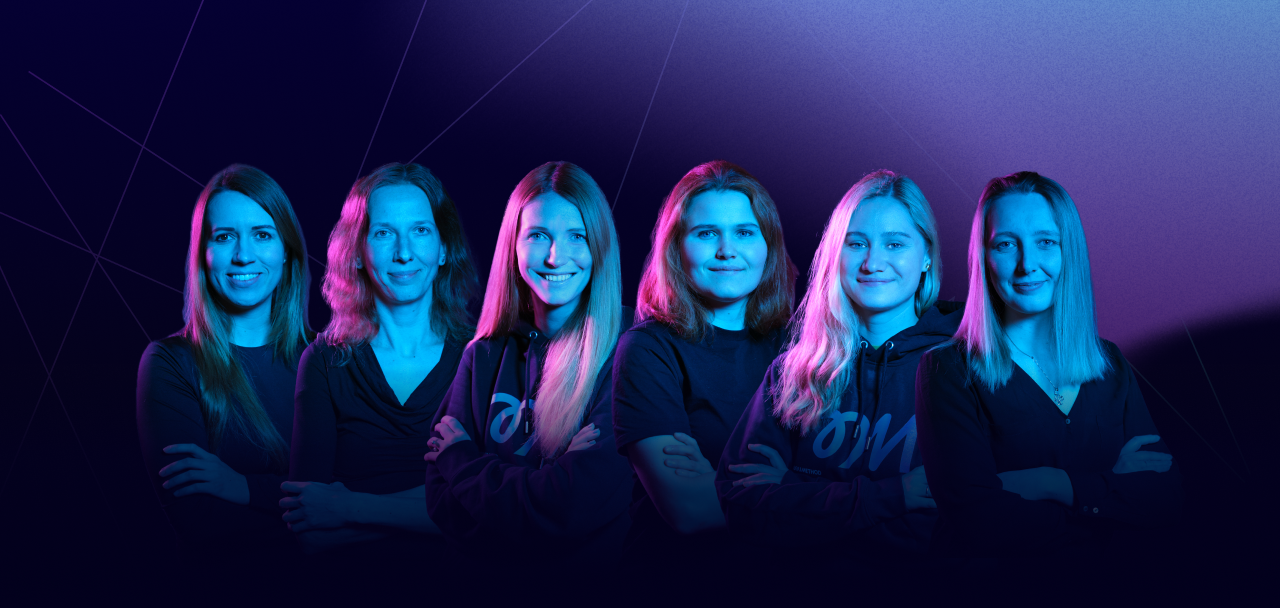
This article was created collaboratively by the women of MeguMethod: Magda Březinová, Lucie Burešová, Karolína Droscová, Petra Fritsch, Karolína Stará, and Anna Vostruhová.
No program. No quotas. Yet it works.
At MeguMethod, we don’t have a diversity program. We don’t have quotas, women’s mentoring groups, or special initiatives supporting women in tech — although we have nothing against such initiatives. We just (perhaps for now) don’t need them. One Slack channel called #megu-girls is enough.
Women in our company hold key roles: they lead projects, design hiring processes, shape products, test quality, and write code.
This isn’t a coincidence, and it isn’t a marketing story. It’s the result of a culture that everyone in the company has been building for eleven years. Not specifically for women, but for people with whom we work well. Because change doesn’t start with processes or diversity programs — it starts with mindset.
“Right now we have the highest number of women we’ve ever had in the company, and I’m really glad about that. There have always been few women in IT, and in my opinion any homogeneous team tends to have worse dynamics. It doesn’t matter whether it’s all men or all women — both extremes create a specific atmosphere that lacks diversity. A mixed team simply has something extra.”
— Vratislav Zima, CEO of MeguMethod
We decided to take a closer look: is it just a feeling, or is there something behind it?
We started with data and then moved to the source itself — the women at MeguMethod. Over the next few weeks, we’ll publish a series of interviews with our colleagues, exploring how they perceive working in the IT sector from a woman’s perspective.
We’ll move from industry-wide statistics to real practice and firsthand stories. Through the experiences of women at MeguMethod, we’ll show what it looks like when a workplace relies not on quotas but on fairness, autonomy, and trust.
What the Data Says (and Why We Don’t Rely on Programs Alone)
Before letting individual women share their stories, it’s worth looking at the broader situation for women in tech.
Where We Stand in the Czech Republic
The Czech Republic has the lowest share of women in ICT in the entire European Union.
According to Eurostat, women represented only 13% of ICT specialists in the Czech Republic in 2024. The EU average is 19.5%. Estonia has 27.6%, Romania 27.3%, and Bulgaria 27%.
We rank worse than Hungary and Malta.
The trend is improving, however. In 2020, the share was 10.3%, meaning it increased by almost three percentage points in four years — faster growth than the EU average, which rose by only 2.8 points over an entire decade since 2014.
For context: in 1993, women made up roughly 36% of IT professionals in the Czech Republic. Most worked as computer operators or in technical support roles. As automation transformed the industry, the share dropped dramatically to around 10% by 2015.
It’s not that women don’t want to work with technology. Somewhere along the way, we lost them.
Where exactly? Perhaps we’ll find out in the upcoming interviews with the women who work at MeguMethod and who will share their stories.
Who Leaves — and Why
One of the most persistent myths about women in tech is predictable: they leave because of children.
But the data says otherwise.
The Lovelace Report (2025) found that only 3% of women cited childcare as the main reason for leaving tech.
Three percent.
A 2020 study by Accenture and Girls Who Code showed that 50% of women leave the tech sector before the age of 35. But not because of motherhood.
Because of the environment.
Across studies, the reasons repeat themselves — and they’re surprisingly specific:
- About one quarter of women cite lack of career advancement.
- Women in tech wait over three years on average for promotion, compared to roughly two years as the industry standard.
- 40% cite poor management as the main reason for leaving (Skillsoft, 2024).
And this isn’t only about IT. Poor management is also a major hidden driver of women leaving finance, law, consulting, and healthcare.
But IT is demonstrably worse.
Women leave tech 2.5 times more often than other office professions, and only half as many women as men reach their first managerial role.
Another third mention lack of recognition and unfair compensation.
According to the Kapor Center Tech Leavers study, 37% of people who voluntarily left tech companies cited unfair treatment as the main factor, and 78% experienced some form of workplace injustice.
The problem isn’t women.
The problem is environments that don’t work for them.
This is where our experience connects.
At MeguMethod we build on fairness, direct feedback, and autonomy. Not because we want to retain women specifically, but because we want to operate fairly regardless of gender.
And it turns out that this exact combination is what keeps women in tech.
The Pay Gap Exists — Even in Czech IT
The gender pay gap in the Czech ICT sector is around 16–18% in the private sector.
Men in ICT earn about 17,000 CZK more per month on average, with the average salary around 94,000 CZK.
Eurostat reports an unadjusted pay gap of 12%, but the adjusted difference for the same role at the same employer is about 10% — twice the European average.
This will change soon.
The EU Pay Transparency Directive requires implementation into national legislation by June 2026, with the first reporting by companies with over 150 employees due by June 2027.
If a pay gap exceeds 5% and cannot be justified, companies will be required to take corrective action.
For many Czech companies, this will be a harsh wake-up call.
Why Programs Alone Aren’t Enough
Intuition suggests a simple equation:
If there’s a problem — create a program.
Introduce diversity training.
Set quotas.
But research suggests it’s not that straightforward.
The most comprehensive study on this topic was conducted by Frank Dobbin and Alexandra Kalev from Harvard. They analyzed data from 829 U.S. companies over more than 30 years.
Their finding is counterintuitive:
Mandatory diversity training, hiring tests, and complaint systems actually decreased the representation of women and minorities in management.
Not increased.
Why?
People resist rules they perceive as pressure.
Managers who undergo mandatory diversity training often leave with greater resistance toward the groups they were supposed to become more supportive of.
Two-thirds of HR professionals confirm that such training has no positive effect.
Three independent meta-analyses (Bezrukova 2016, Forscher 2019, Paluck 2021) — together analyzing over a thousand studies — confirm the same conclusion:
The real behavioral impact of mandatory diversity training is statistically close to zero.
These studies do not say diversity is useless.
They simply dismantle the myth that diversity can be enforced by putting people in a room for a mandatory PowerPoint presentation.
What Actually Works
Voluntary approaches.
- Voluntary training programs increased representation by 9–13%
- Formal mentoring programs by 9–24%
- Diversity task forces by 9–30%
The key difference?
Involving people voluntarily.
Giving them responsibility.
Making them part of the solution.
Not telling them what they’re doing wrong.
Which is exactly the approach we’ve been living at MeguMethod for years.
A BCG global survey of 16,500 people found that 59% of women consider flexible work the most effective measure for gender diversity.
Senior male leaders ranked it only eighth.
Coincidence? We don’t think so.
The gap between what women actually need and what leadership thinks they need is, according to BCG, one of the biggest barriers to retention.
Another number is telling.
Accenture research shows that if every company scored highly in inclusive culture, the annual attrition of women in tech would drop by 70%.
The Kapor Center found that more than half of women who left would have stayed if their company had simply created a fairer environment.
No quotas.
No special programs.
Just a fairer workplace for everyone.
What Does a “Fair Environment” Actually Mean?
The study deliberately didn’t define the term, because it wanted to capture real experiences rather than checklists.
But the stories people shared were concrete:
- being overlooked for promotion
- others taking credit for their work
- stereotypical assumptions about competence
- bullying
- humiliation
Everyday behaviors that cost companies an estimated $16 billion annually in employee turnover.
What We Take From It
We don’t have a universal formula.
There are many things we don’t yet have to solve because we’re still a relatively small company.
But we do have an environment where women feel comfortable (even if the toilet seat is occasionally left up).
And our stories suggest something similar to what the research shows:
Culture is the foundation.
But not every company has the advantage that culture emerged organically.
Research is surprisingly clear here:
Mandatory training that points fingers and says “behave better” rarely improves things.
What works is:
- involving people
- giving them space and responsibility
- investing in management
- talking about problems openly
Because if leadership doesn’t live the values a company claims to have, no program will save it.
Many companies today have diversity programs.
But according to the studies mentioned above, only a small share of employees from diverse groups say those programs bring them real value.
That’s a huge gap between intention and real impact.
We’re lucky to be a small team where everything is visible.
We don’t focus on gender.
We focus on whether we work well together.
Instead of checkboxes, we build on trust, autonomy, honesty, and humanity — things that research shows work better than most formal programs.
The question is whether — and how — this can scale to larger companies.
We don’t know everything.
But we are certain about one thing:
If women needed special treatment to succeed at MeguMethod, the problem would be with the company — not with them.
In the coming weeks, we’ll let the women of MeguMethod speak for themselves.
Their stories, experiences, and perspectives on what it’s like to work in an environment that focuses not on gender, but on contribution and quality.
You’ll gradually meet:
- Petra (People & Culture)
- Lucie (Project Management)
- Karolína S. and Anička (Design)
- Karolína D. (Development)
- Magda (QA)
Together we’ll explore how we perceive inequality — and what it means to work in IT while being in the minority.
Because the best answer to the question “How does gender equality actually work in your company?” can come mainly from us.
The women it concerns.


