ISIC: A global love brand, Swift 6, and a refactor that makes sense
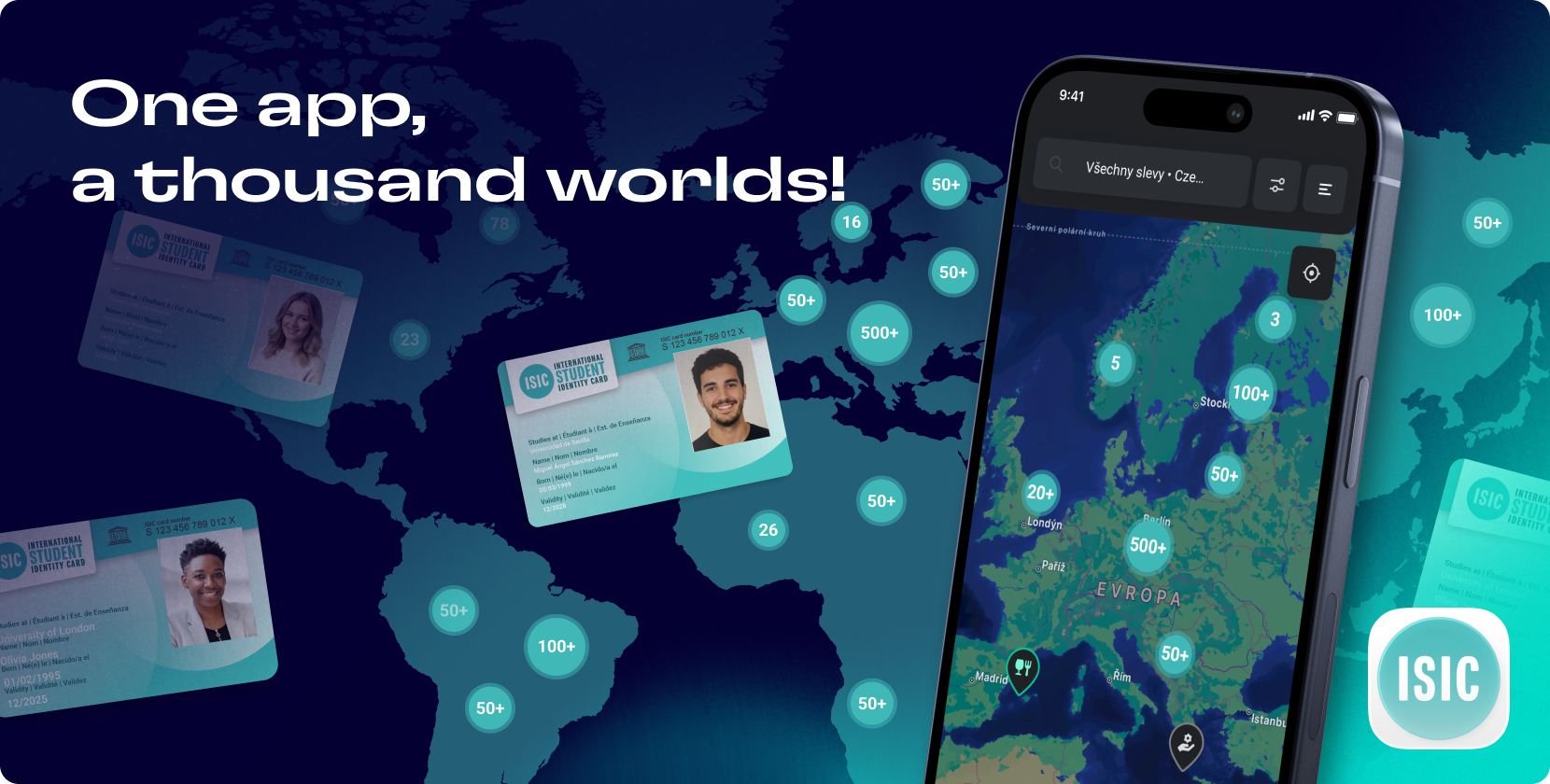
When you say ISIC, most students around the world think of the same thing: a green card, discounts, and an essential part of student identity. For us at MeguMethod, however, ISIC means something more. It is a project where, for more than five years, our passion for clean code has met a systematic approach to building a truly global product.

We are not creating just “another app,” but a tool carried in the pocket of students in Berlin, Madrid, and Santiago de Chile alike. Every single line of code influences the experience of more than one million active users worldwide.
When you have 24,000 users a day in your hands
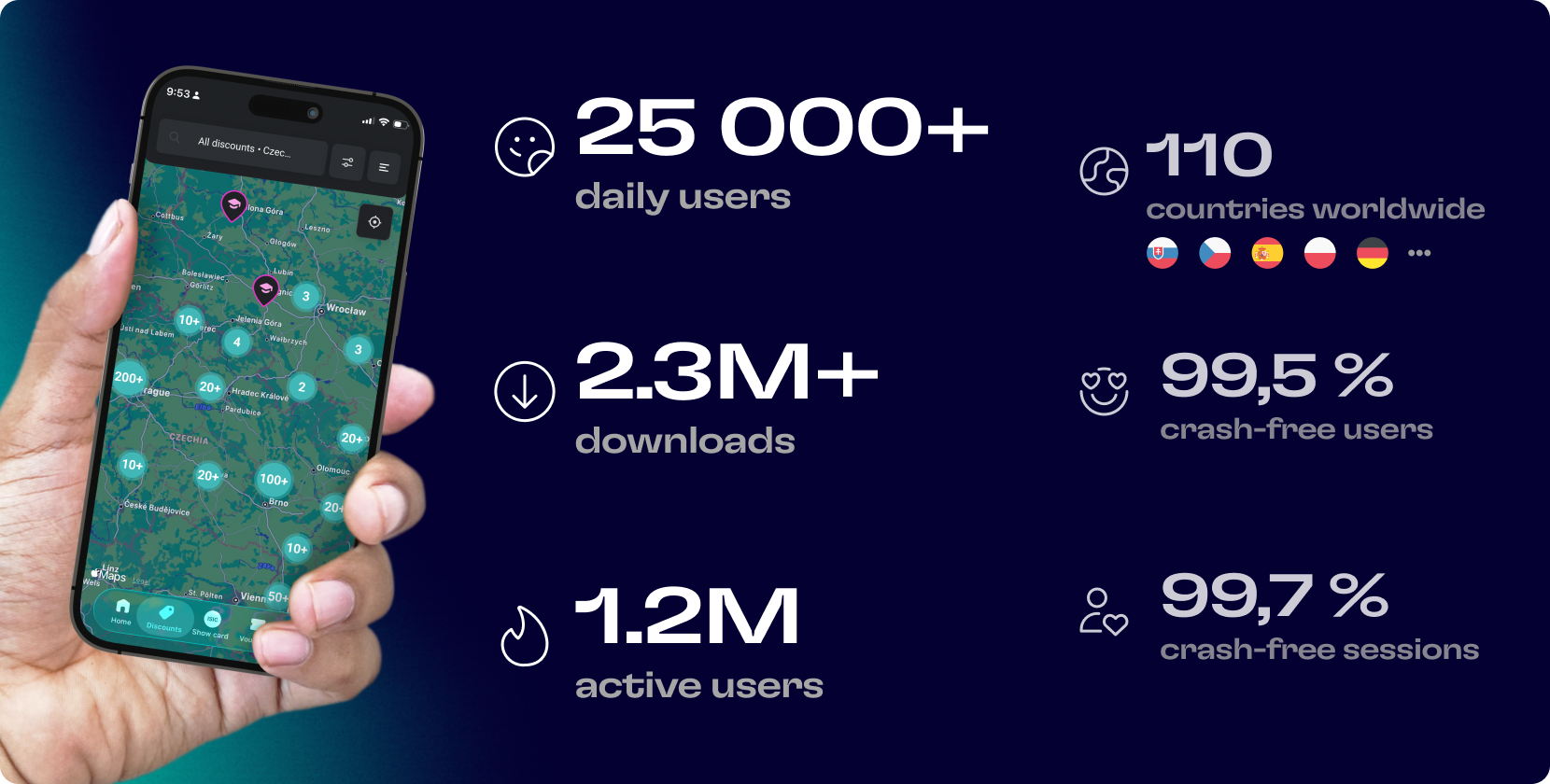
To be specific, ISIC is not a small project for a handful of enthusiasts. It is a robust ecosystem with impressive numbers. More than 25,000 users actively use the app every day across continents, with our strongest user base in Slovakia, Czechia, Spain, Poland, and Germany. Overall, the app has over 2.3 million downloads and 1.2 million active users, making it one of the key touchpoints of the entire ISIC brand, which operates in 110 countries worldwide.
With this scale, we cannot afford to experiment at the expense of stability. We are proud to maintain an extremely high standard of reliability over the long term. The numbers speak for themselves: 99.5% crash-free users and 99.7% crash-free sessions. This is the result of carefully set processes and QA that do not allow anything to be released unless it is both pixel-perfect and stable.
“To maintain high stability, regular monitoring and sufficient insight are essential. That’s why we use comprehensive logging in the app, which allows us to resolve potential issues efficiently. With such a large number of users, problems can never be avoided completely, but they must be addressed continuously.” David Třešňák, Senior iOS Developer
The Big Refactor of 2025: Cleanup, Swift 6, and a Fresh Visual Look
After five years of development, we faced the classic dilemma of every long-term software project. You can either keep patching older code indefinitely, or take a deep breath and prepare the app for the next five years. We chose the harder, but right, path. We embarked on a massive technological and visual update.
The goal was not just to rewrite the code, but to push our technology stack to the cutting edge. We migrated to Swift 6, which brought a major upgrade in safety and a modern concurrency model. At the same time, we addressed technical debt from the days when SwiftUI was still in its infancy. Today, best practices are in a completely different place, so the refactor made perfect sense for the long-term sustainability of the project.
“During the refactor, 38 screens had to be redesigned without changing their functionality. This required a lot of focused work and thorough testing.” David Třešňák, Senior iOS Developer
Technology and design went hand in hand. We adopted the Liquid Glass visual style, Apple’s new design language introduced with iOS 26. The result is a cleaner UI and a modern look that resonates with Generation Z. We didn’t want the app to feel like a corporate tool from the last decade, but rather like a modern love brand for today’s students.
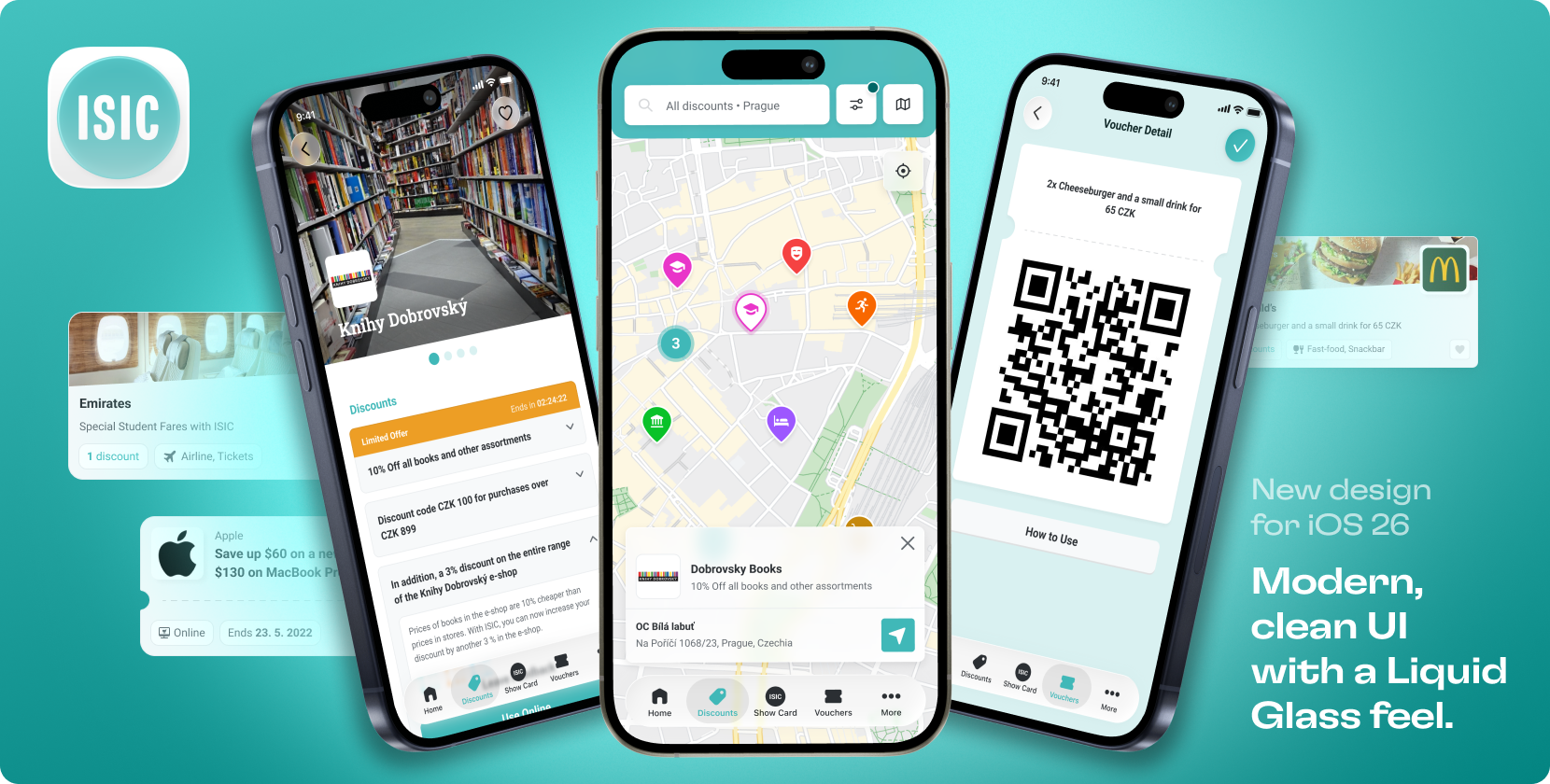
“ISIC was one of my first large projects, and I still have a good feeling about it today. It’s great to know that an app I worked on is used by students all over the world and truly helps them in their everyday lives. It was even nicer to come back to it after a few years and modernize the design in the spirit of Liquid Glass – it was a fun and natural evolution that benefited the ISIC project a lot and refreshed it.” Lukáš Všetečka, Designer
It’s not a weekend job, it’s ant-level work
A refactor like this doesn’t happen overnight. It was an operation that lasted several weeks, where we combined “brute force” with smart solutions. We used AI assistance to speed up routine tasks, but the core of the work still relied on the care and precision of our developers and designers.
Coordination is another major challenge. The app is a global “octopus” connected to dozens of partner systems. Every change has to be aligned not only internally, but also with the backend team at Orchitech, local ISIC organizations around the world, and, of course, under the strict eye of Apple App Review. This is where our ability to work transparently and openly within a multi-team structure really shows.
“I sort of took over ISIC organically – someone needed to work on it, and the project stayed with me. I’ve been responsible for the Android platform for several years now. Since in recent years we’ve mainly been providing support, work on ISIC is more intermittent and a welcome change from other projects. Sometimes the context switching is more demanding, especially when there’s a lot going on, but other times it’s a pleasant change of pace. I’m proud that the project still maintains such a high number of crash-free sessions and remains easy to maintain.” Lubomír Baloun, Senior Android Developer
RTL support and other technical challenges
For developers, ISIC is interesting because it forces us to solve problems you don’t encounter in local apps. A great example is support for RTL (right-to-left) languages. Since the app is also used by students in countries where text is read from right to left, we had to completely mirror the UI. Most apps don’t deal with this – we had to.
Another layer of complexity is multi-regional content. What a student in Germany sees is different from what a student in Brazil sees. Different discounts, different rules, different features. And there are many discounts – ISIC offers thousands of discounts at tens of thousands of locations worldwide. This requires robust logic on both the frontend and backend, and high compatibility with tools such as Benefit Manager.
But the mobile app is only the tip of the iceberg. Behind it stands an extensive ecosystem of tools for partners.
Benefit Manager: The ecosystem behind the scenes
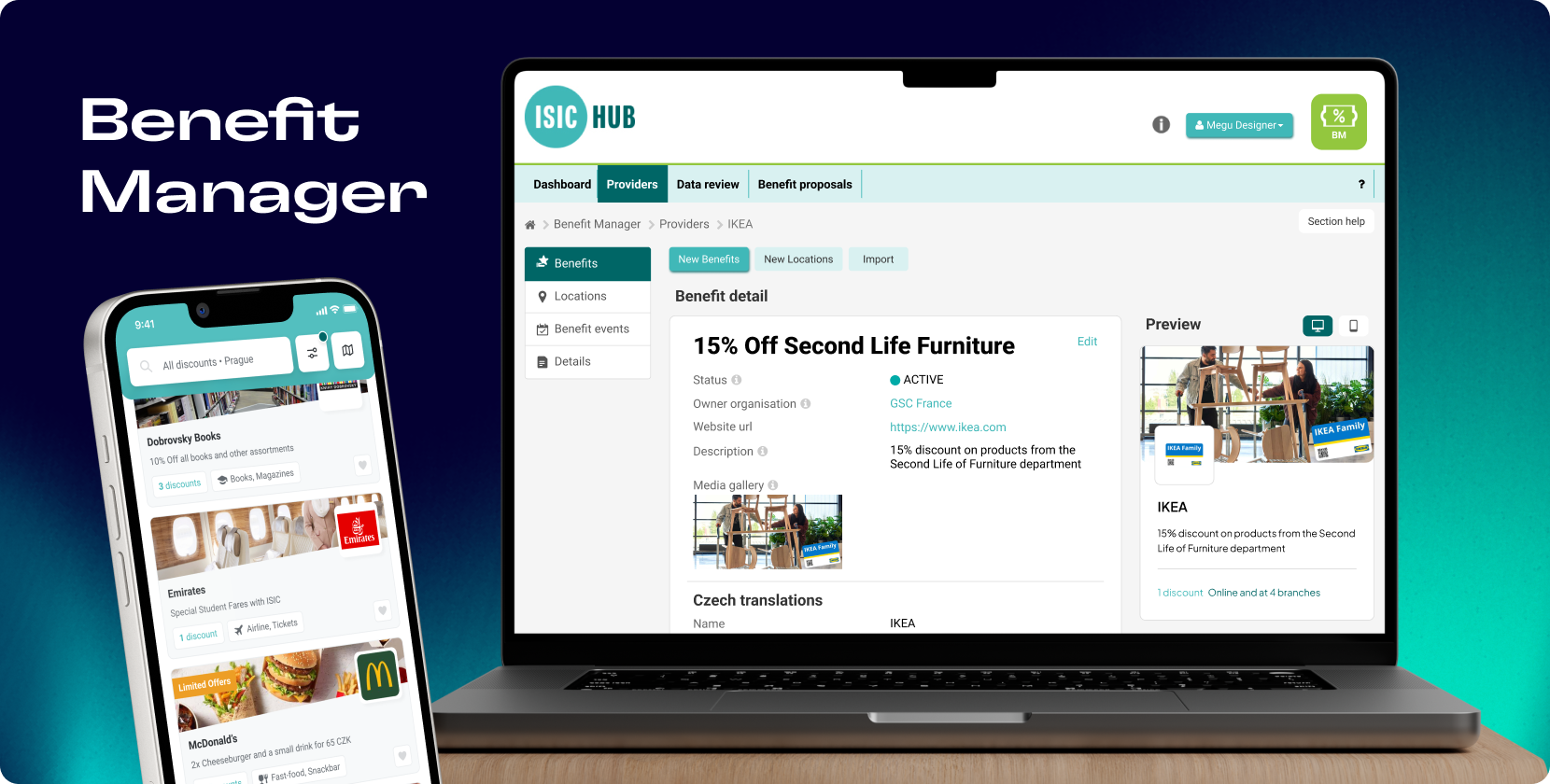
When talking about ISIC, we cannot omit Benefit Manager. It is a tool for managing ISIC partners – shops, institutions, and e-shops – through which new discounts, campaigns, and profiles can be easily and clearly added directly into the app. So it’s not just a mobile app, but an entire ecosystem that is currently undergoing a comprehensive redesign.
“Working with such a complex product requires a sensitive approach and a deep understanding of the context. I really appreciate that at MeguMethod there is a high level of ownership – I can present my designs directly to the client, get immediate feedback, and actively participate in decision-making.” Karolína Stará, Designer
Partner perspective
We have been helping ISIC with system development for more than 15 years. It is a central platform ensuring interoperability between individual issuers worldwide, so it requires extreme robustness and stability. In the digitization of services traditionally based on plastic cards, the mobile app plays a key role. However, it must combine the requirements for a modern and intuitive user interface with compatibility with the established platform and processes.
“Cooperation with the MeguMethod team is excellent. They designed and developed a mobile application that satisfies not only the client but, above all, the users. They also proactively keep the app technologically advanced. I appreciate their careful approach, flexibility, and ability to find elegant solutions even in complicated conditions.” Ondřej Urbánek, Solution Architect, Orchitech
What does it all mean?
ISIC shows how we work. It is exactly the kind of project where developers grow. They work with the latest technologies like Swift 6 and SwiftUI, their code has a real impact on hundreds of thousands of people every day, and it’s not about being locked away somewhere in a corner, but about communication across teams and continents.
The results speak for themselves: an app with a 4.5-star rating that maintains top-level stability over the long term and, after a major refactor, looks and works better than ever before.
“Responsibility for maximum code safety is something you learn very quickly on ISIC. With a high number of users and a high number of app launches, you realize that even the smallest mistake in logic or concurrency will show up.” David Třešňák, Senior iOS Developer