


Vibe coding in your company: how a CTO gets it under control
People in your company already build with AI. How to set rules, an environment, review and an inventory so vibe coding brings results, not risks. For CTOs.

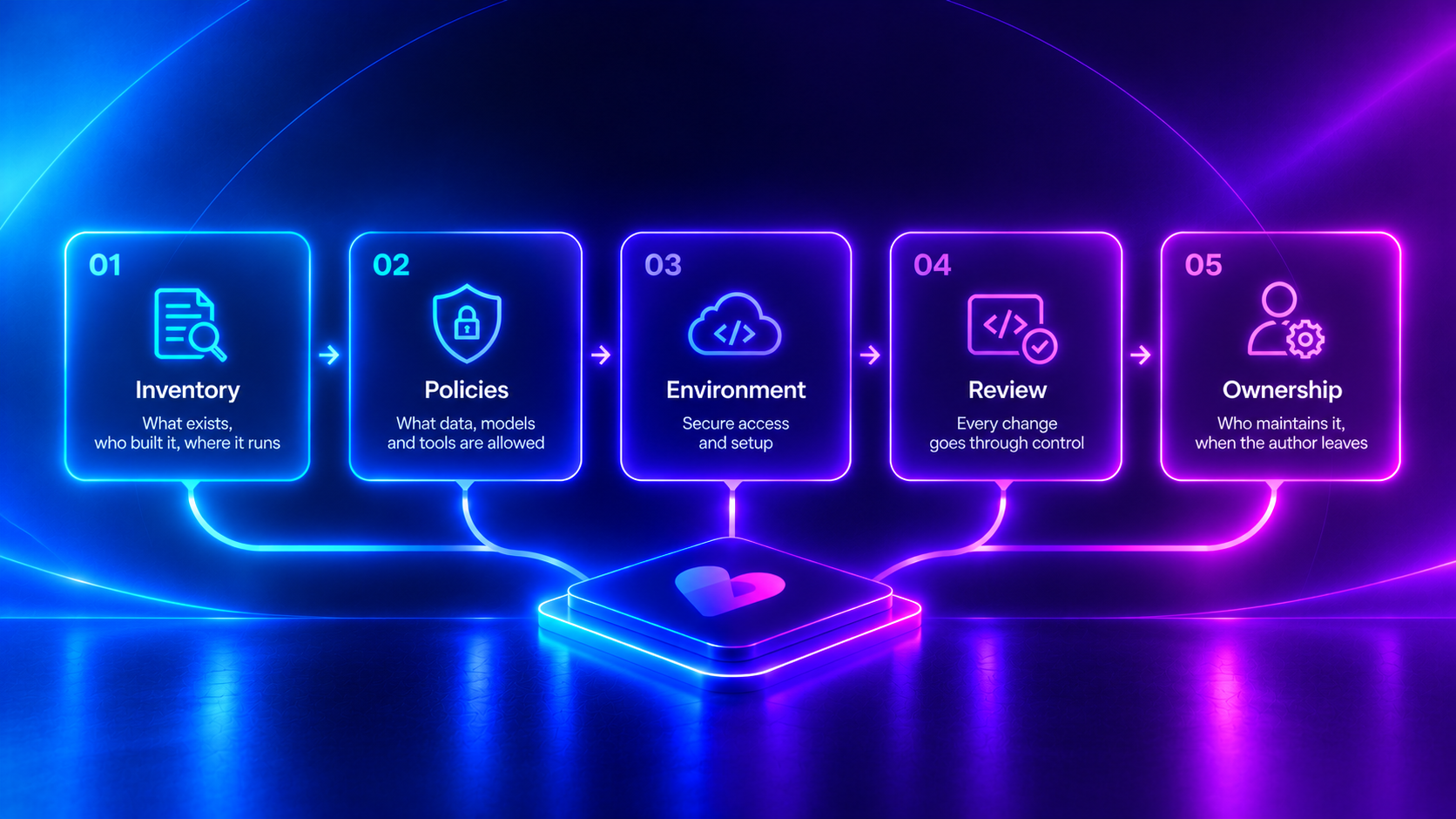
Short answer: You get vibe coding in your company under control in five steps: an inventory of what people have already built with AI, rules for data and models, a shared environment and access management, mandatory review of every change, and clear ownership of what runs in production. A ban doesn't work, because people keep building, just out of sight. The CTO's goal is not to stop vibe coding but to move it to where it can be seen.
Why it matters
Development with AI is already happening in companies, whether the CTO approved it or not. According to the Stack Overflow Developer Survey 2026 (30,903 respondents from 169 countries, results published on 6 October 2026), 66% of respondents use AI assistants or agents for coding, and 73% of them daily. At the same time, 48% trust AI output only when they can easily verify it. And only 24% of respondents say their company has approved AI tools and rules for using them; for another 30%, AI use at work is optional and left to the individual. In other words: almost two thirds of developers use AI tools, but only a quarter of companies have approved tools and rules. That is not a contradiction, it is a description of the situation a CTO has to manage.
A second number explains why this matters beyond the development department. In 2025, Veracode tested more than 100 language models on 80 coding tasks, and in 45% of cases the models produced code with a security flaw even though a secure option existed. Vibe coding, meaning development where a person describes what they want and AI writes the code, doesn't produce these flaws on purpose. Nobody just checks for them, unless the company has defined who reviews code and how. At MeguMethod we have named this as the four risks companies bring to us in AI Ops: leaks of sensitive data, dependence on the author, duplicate development and unmaintainable applications.
Want to know what has already been built with AI in your company and where the biggest risks are? Book 30 minutes online with us. We will go through who is building what, where it runs and what it touches. Book an online call
What happens in a company when people build with AI without rules
Without rules, a parallel IT emerges in the company that nobody sees and nobody is accountable for. It isn't just developers. A salesperson has a script written that pulls data from the CRM into a spreadsheet. An analyst builds an internal reporting app. Marketing creates a tool that sends customer data to an external model. Each of them solved their own problem, and none of them has a reason to report it.
The CTO usually learns about these tools in three situations: when they stop working, when their author leaves, or when someone asks where the data actually goes. By then, changing anything is expensive. The tool is part of someone's workflow, the code sits in someone else's account and nobody but the author knows what it does.
The key point is that the problem is not that people build things. The problem is that they build without an environment that would give them safe guardrails. People take the path of least resistance. If the easiest path is "upload the data to a public model and have it write an app", they will take it. If the easiest path is "a company environment with ready-made tools", they will take that one. The CTO's job is to make the second path the easier one.
Step 1: Inventory. What has already been built with AI and where it runs
The first step is not a rule but a list. Before you ban or allow anything, you need to know what exists. The inventory answers four questions about every tool or application: who built it, where it runs, what data and systems it touches, and who uses it today.
The fastest way to an inventory is not an audit but an amnesty. Tell people you want to know what they have built and that nobody will hold it against them. Most people are proud of their tools and happy to show them. If you start with an inspection, the inventory will be incomplete, because people will hide whatever they fear being punished for.
The inventory usually shows that some tools are harmless (a script for renaming files), some are valuable and deserve strengthening (an internal app used by a whole department) and some are risky (anything that sends customer data outside the company). Only with this list does it make sense to set rules. It is also exactly the first step we take in AI Ops: mapping what is running in the company.
Step 2: Rules. What may go into a model and what may not
The most important rule is not about code but about data. Everyone in the company must know what they may send to an AI model and what they may not. It is simple to state and hard to follow, because an AI tool cannot tell test data from a production customer database.
Our view: rules should be short and concrete, not a twenty-page policy. An example of the structure we recommend:
Which models and tools are approved. A list of providers and accounts through which the company works with AI. Company accounts instead of personal ones, because with a company account you know the data processing terms, and with a personal one you don't.
What must never be sent to a model. Customers' personal data, credentials, API keys, business contracts, source code of products where the licence or the client contract forbids it. This list belongs where people work, not on an intranet nobody visits.
Where code may be created. One company version control system (typically Git) that holds everything used more than once. Code in a personal account, on a local disk or only inside an AI tool is not a company asset, it is a risk.
Who decides on exceptions. Rules without an owner are not followed. One person or a small group able to answer the question "can I use this tool on this data?" within the day.
Data rules are an area where it pays to check with a lawyer what GDPR and any other regulation means for you. In this article we describe general principles; the specific setup for your company is a matter for legal advice.
Step 3: Environment and access. Give people a safe path
Rules only work when following them is easier than getting around them. So the third step is not another document but an environment in which people build with AI safely without having to think about it.
What such an environment contains:
Approved tools with company access. Whether the team uses Claude Code, Codex, Cursor or other tools, access and keys are managed by the company, not by individuals. When someone leaves, the access is switched off. When a provider changes its terms, the company knows. How to roll these tools out in practice, from access through project rules to review, is covered in our separate guide to AI coding agents in your company.
Rules directly in the project. Modern AI tools can read an instruction file stored in the project: which technologies we use, how things are named, what gets tested, what must not be done. Instructions in the repository apply to everyone working with the project, including AI. It is the cheapest way to keep a consistent stack without explaining it to everyone.
A ready-made connection to company data. If people need an AI tool to see internal documentation or systems, give them an approved path, for example via MCP (Model Context Protocol, an open standard for connecting AI tools to data). An approved path means you know which tool touches which data and with what rights. An unapproved path means everyone does it their own way.
Separate environments for experiments and for production. Vibe coding is great for a prototype. But a prototype must not run on live customer data. Separating development and production environments is basic hygiene that AI tools do not provide on their own.
This is also the part where a CTO most often decides between "we build it ourselves" and "we have it built". Both are legitimate; we compare the two paths in general in Vibe coding or a development team. It depends on whether you have people on the team who will not only build the environment but also maintain it.
Step 4: Review. Every change goes through a check
Code written with AI must go through the same review as code written by a person, and in some respects a stricter one. The reason is the one Veracode showed: a model produces working code with a security flaw without anyone noticing at first glance. Functionality shows immediately, a vulnerability only during an attack.
Review has two layers. The first is automated: tests, static analysis, dependency checks, security scans and automated AI code review that goes through all the code and finds potential bugs. It runs on every change and stops what obviously shouldn't pass. The second is human: an experienced developer looks at the architecture, at how data and access are handled, and at whether the code does what it should and nothing more. There is so much AI code that a person cannot efficiently review all of it by hand; so automation handles the routine and the person deals with significant risks and the stability of the foundation. For AI code the human layer is more important, not less, because the author often cannot explain why the code looks the way it does.
For the CTO this leads to a practical decision: who reviews tools built by people outside the development team. A salesperson won't review their own script. Either the internal team does it, or a partner. At MeguMethod this is the fourth step of AI Ops: automation and our engineers oversee the code created in the company and check every change for security, architecture and functionality. At the level of a single product we use the same principle in App as a Service, where every change is checked by automation and by our engineers before it goes live.
The most common security flaws that review prevents are described in our separate article on the security of apps written with AI.
Step 5: Ownership. Who maintains the tool once the author leaves
Every tool the company uses needs an owner, and not only an author. The author built the tool, but the owner is accountable for it: they know it exists, know what it depends on, and have a plan for what happens when it stops working or when the author leaves.
This is the risk we call dependence on the author: a tool built with AI that only the person who described it to the model understands. When they leave, the tool keeps running and nobody can fix it. The protection is easy to describe: code in the company repository, a few paragraphs of documentation on how to run the tool and what it does, and a second person who has seen it at least once.
The second risk is duplication. Without an inventory, three departments build three versions of the same tool. Each is maintained separately and each has different bugs. A central list of projects that people check before they start building is cheaper than three tools.
This part is also connected to a wider phenomenon called shadow AI: people use AI tools and build their own solutions without IT knowing. We cover it in a separate article. For the CTO the key point is that ownership cannot be imposed retroactively. It has to be part of the rules from the start.
When to support vibe coding in your company and when to slow it down
Support vibe coding when:
- people build internal tools for themselves and their team, and the data they work with is not sensitive,
- it is a prototype or a first version that validates an idea and will never go to customers without being rebuilt,
- you have an environment where the code belongs and someone who will review it,
- the tool replaces manual work that nobody would otherwise automate because there is no budget for it,
- the author is willing to document the tool and hand it over.
Slow vibe coding down when:
- the tool touches customers' personal data, payments or credentials and nobody has reviewed it,
- the code exists only in a personal account or inside an AI tool and the company has no access to it,
- a whole department depends on the tool and only one person understands it,
- the application is meant for paying customers and has never been through an architecture and security review,
- people use it to bypass IT, not to solve a problem IT isn't solving.
Our view: the difference between the two lists is not in the tool but in whether the company has an environment, rules and review. With them, vibe coding is acceleration. Without them, it is debt that comes due when you least expect it.
If the second list sounds like you, send us a few sentences about what is being built with AI at your company. We will get back to you with how we would approach it. Send an inquiry
How MeguMethod approaches it
In AI Ops we do exactly the five steps in this article for companies, just with our people and tools. First we map what runs in the company: who is building what, where it is hosted and what it touches. Then we set rules for the stack, the environment and deployment. We equip and train the team: it gets AI skills and MCP for the models it already uses, access to a list of all projects built with AI, and a practical workshop on vibe coding without losing quality. And finally we oversee the code: every change is checked by AI and by our engineers for security, architecture and functionality.
We start with a 30-minute online consultation with no commitment. We go through what your people are building, where it runs and what it touches, and you leave with a concrete list of risks and first steps. If you are dealing with one specific product that needs to go live, App as a Service is the better fit for you.
Next step
Want to keep AI development in your company under control without slowing it down? See how AI Ops from MeguMethod works, or book 30 minutes online and we will go through what is being built with AI at your company. If you would like some context first, read what vibe coding is and where its limits are.
Related reading from our blog: AI agent: what it is and how a company can use it and AppParade 37 Report: four AI trends.
FAQ
Should I ban vibe coding in my company?
In our experience a ban doesn't work, because people keep building, just out of sight. It is more effective to give them a safe path: approved tools with company access, data rules and an environment where the code belongs. A ban makes sense only for specific data, such as customers' personal data or credentials.
How do I find out what people in my company have already built with AI?
Fastest through an amnesty: tell people you want to know what they have built and that nobody will hold it against them. Ask four things: who built the tool, where it runs, what data it touches and who uses it. An inspection instead of an amnesty leads to an incomplete list.
Is code written with AI secure?
Not always on its own. In 2025, Veracode tested more than 100 models on 80 tasks, and in 45% of cases the code had a security flaw. It becomes secure only through review: automated tests, scans and AI code review plus a check by an experienced developer who assesses the architecture and the handling of data.
Who should review tools built by people outside IT?
Someone who can read code and didn't work on it: the internal development team, or a partner. It isn't a full audit of every script, but an assessment of what touches sensitive data or what a whole department depends on.
What does dependence on the author mean and how do I prevent it?
A tool built with AI that only the person who described it to the model understands. When they leave, the tool keeps running and nobody can fix it. You prevent it with code in the company repository, short documentation and a second person who knows the tool.
How long does it take to get vibe coding in a company under control?
It depends on how many tools already exist and how sensitive the data they use is. The inventory and basic rules can be done quickly; the environment and review take more time and someone to maintain them. That is why we recommend starting with mapping, not with a policy.


